
You step on a scale and your numbers tell a story of where you’re headed, not just where you stand today. By 2026, you’ll see 8–14 core metrics—weight, body fat, muscle, BMI, visceral fat, water, BMR, bone mass—plus subcutaneous fat, skeletal muscle, and body age, all with sharpened 0.1 lb precision and auto-recognition for multiple users. Curious how these gauges fit your routines and sync with Apple Health, Google Fit, or Fitbit? Let’s map out the top options.
Key Points
- Identify scales offering 8–14 core body metrics (weight, fat, muscle, BMI, visceral fat, water, BMR, bone mass) for comprehensive tracking.
- Prioritize models with 8-electrode or dual-frequency BIA for accuracy across segments and users.
- Look for auto-recognition, multi-user support, and guest modes to manage family or household profiles.
- Check app ecosystems (Apple Health, Google Fit, Fitbit) and long-term trend analytics for cross-device synchronization.
- Ensure reasonable weight capacity (≥400 lb), clear displays, and offline mode options for basic reads without the app.
NUTRI FIT 7-in-1 Digital Body Scale with App
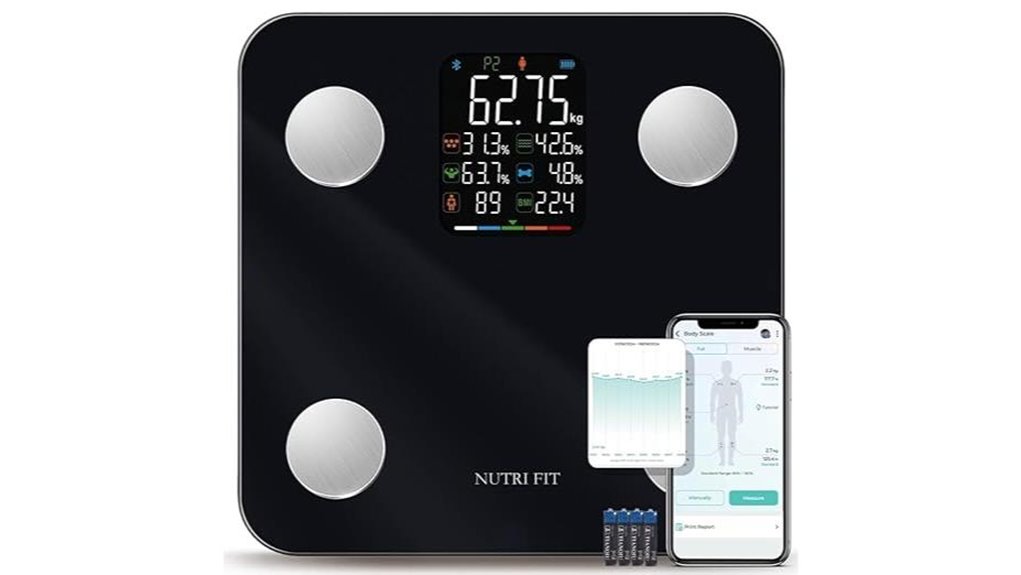
If you want a 7-in-1 scale that automatically recognizes users and tracks a full range of metrics, the NUTRI FIT Digital Bathroom Scale is a strong pick. You’ll measure weight, body fat, body water, muscle, protein, bone, BMI, BMR, somatotype, lean mass, AMR, subcutaneous fat, skeletal muscle, visceral fat, and body age with 17 metrics. The device uses 4 high-sensitivity electrodes and auto-calibration via BIA, saving data in the iMoni app and syncing with Apple Health, Google Fit, or FitBit. It supports multiple users, baby/athlete/pet modes, and offline storage, while ensuring easy, precise results at a max 400 lb.
Best For: Busy individuals or families who want automatic user recognition and comprehensive body composition tracking across multiple metrics and apps.
Pros:
- Auto-recognition and 7-in-1 body composition metrics (weight, fat, water, muscle, etc.) with BIA
- Syncs with Apple Health, Google Fit, and FitBit; data can be tracked offline via local storage
- Supports multiple users and special modes (Baby, Athlete, Pet) for versatile use
Cons:
- Not recommended for pregnant women, osteoporosis, pacemakers, or metal implants
- May require app setup and permissions for full syncing across platforms
- Max weight limit is 400 lb (180 kg), which may exclude heavier users and athletes
GE Smart Body Weight Scale with 8-in-1 Display
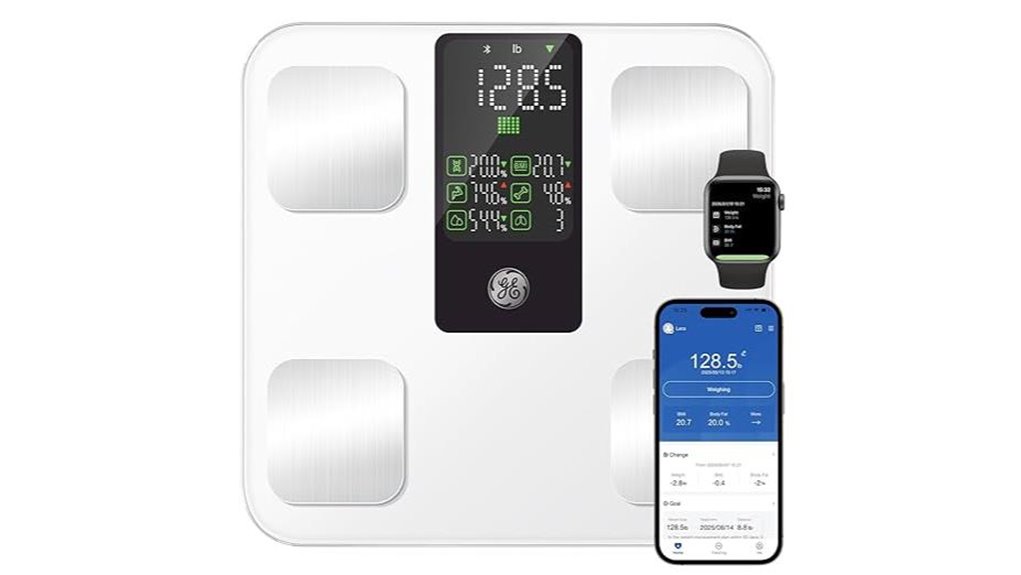
The GE Smart Body Weight Scale with 8-in-1 Display stands out for households seeking a thorough, multi-metric tracker that syncs across major health platforms. You get an 8-in-1 display showing BMI, body fat, and muscle metrics on a bright 5.44″ screen, plus instant Health Snapshot after a one-time setup. Weighing on an 11.8″ platform, it delivers 0.1 lb precision for up to 400 lb, with full-body composition via bioimpedance. It tracks weight, fat, BMI, skeletal muscle, protein, BMR, and more, then syncs to Apple Health, Google Fit, Fitbit, or Samsung Health. Unlimited users ensure private profiles for every member.
Best For: Health-conscious individuals and families who want a comprehensive, multi-metric scale that syncs with major health apps and supports multiple users.
Pros:
- Comprehensive 8-in-1 display with full-body composition metrics (fat, muscle, BMR, visceral fat, etc.)
- One-tap Health Snapshot and seamless data syncing to Apple Health, Google Fit, Fitbit, and Samsung Health
- Unlimited user profiles with automatic recognition and private histories for each household member
Cons:
- Requires initial setup to display all data on the scale
- Not suitable for users with pacemakers or implanted medical devices
- May be overkill for simple weight tracking; larger platform size could be less convenient for very small spaces
LOFTILLA Smart Scale with BMI and Body Metrics
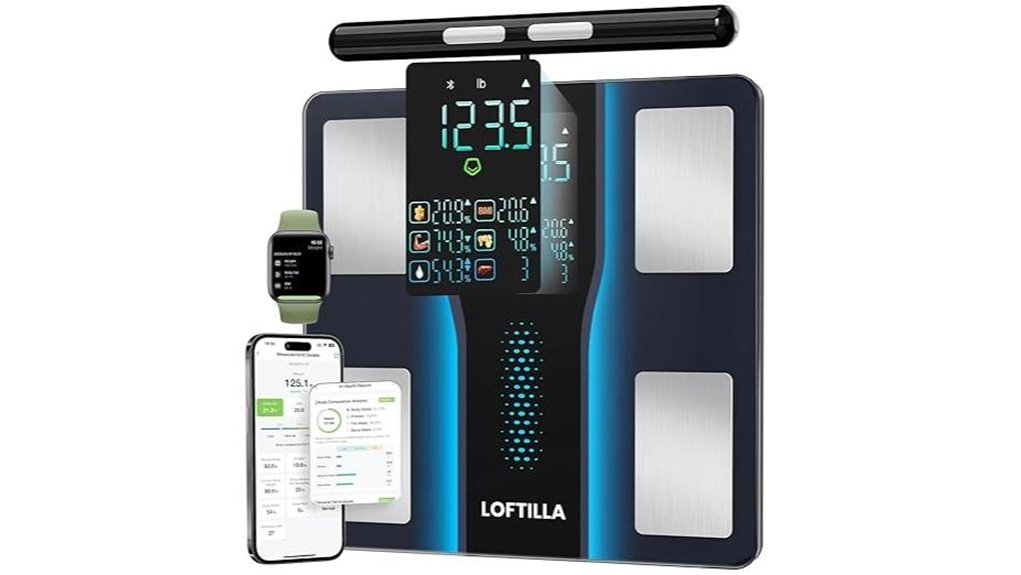
The LOFTILLA Smart Scale stands out for its 8-electrode dual-frequency BIA tech and automatic user recognition, giving you precise body composition readouts for multiple users with minimal setup. You view 5.4″ LED on the unit, with 8 core metrics shown after measurement: weight, body fat percentage, muscle mass, BMI, body water, bone mass, visceral fat, and body type. The device uses hands-and-feet measurements and high-precision sensors (0.1 lb, 400 lb max) for accuracy. Feelfit app syncs 50+ metrics via Bluetooth, plus Apple Health/Google Fit. Long-term, multi-user tracking, automatic app sync, and clear on-device readouts support ongoing health monitoring.
Best For: Individuals or families seeking multi-user, long-term body composition tracking with automatic recognition and app integration for a comprehensive view of health metrics.
Pros:
- Accurate, multi-parameter readouts (weight, body fat, muscle mass, BMI, body water, bone mass, visceral fat, body type) via 8-electrode dual-frequency BIA.
- Automatic user recognition and multi-user profiles simplify use for households or teams.
- Strong app integration (Feelfit with 50+ metrics, Apple Health/Google Fit) and long-term trend tracking.
Cons:
- Requires Feelfit app setup with height and age; not plug-and-play without app pairing.
- Not suitable for people with pacemakers or internal medical devices; pregnancy use not advised.
- Measurements can be affected by surface quality and user adherence to setup (needs flat, solid surface).
GE Smart Scale with BMI, Fat, Muscle, Bluetooth
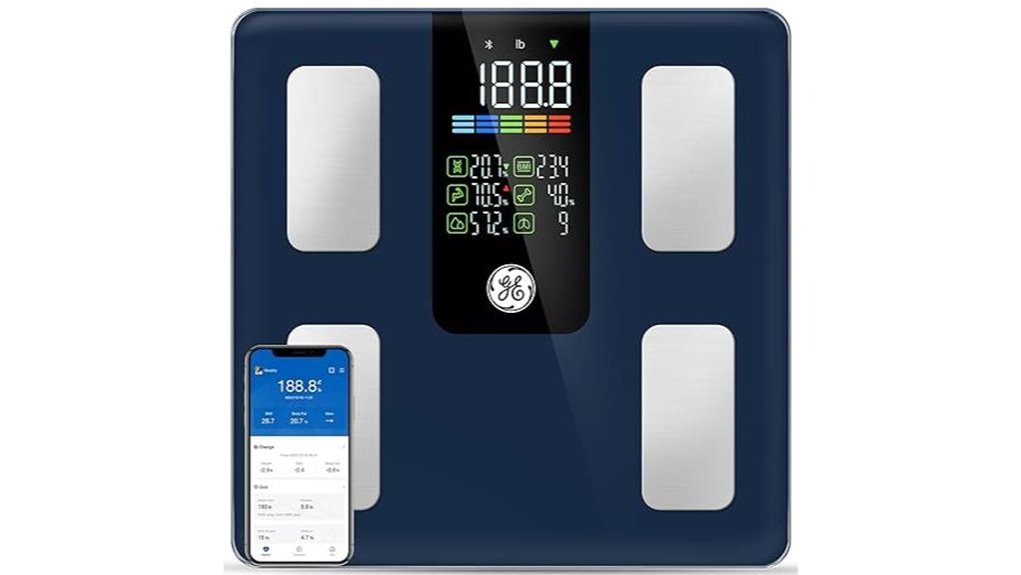
For those tracking a wide range of metrics at home, this GE Smart Scale stands out with its 14 essential measurements—including BMI, body fat, muscle mass, and visceral fat—all synced via Bluetooth to the Fit Profile app. You get weight, body fat %, muscle mass, body water %, bone mass, visceral fat, BMR, BMI, fat-free weight, skeletal muscle, protein, subcutaneous fat, metabolic age, and body type, with readouts at 0.1 lb / 0.05 kg. It cycles data to the Fit Profile app, Apple Health, and Google Fit after a one-time pairing, then displays history on the scale itself. Safe anti-tip base, tempered glass design.
Best For: Those seeking a comprehensive at-home body composition tracker with Bluetooth syncing to multiple health platforms and a large, easy-to-read display.
Pros:
- Displays 14 essential metrics (weight, fat, muscle mass, BMI, visceral fat, BMR, etc.) with 0.1 lb / 0.05 kg precision.
- Syncs via Bluetooth to Fit Profile, Apple Health, and Google Fit, with historical charts saved in-app.
- Anti-tip design, tempered glass platform, and 11.8″ wide surface for stable, comfortable use.
Cons:
- Requires a one-time phone pairing to enable app features; basic use still works without the app.
- Not recommended for pacemakers or pregnancy; may require phone access for full functionality.
- Limited to up to 500 lbs (226.8 kg) capacity, which may be insufficient for some users.
Arboleaf 8-Electrode Body Composition Scale with App Metrics
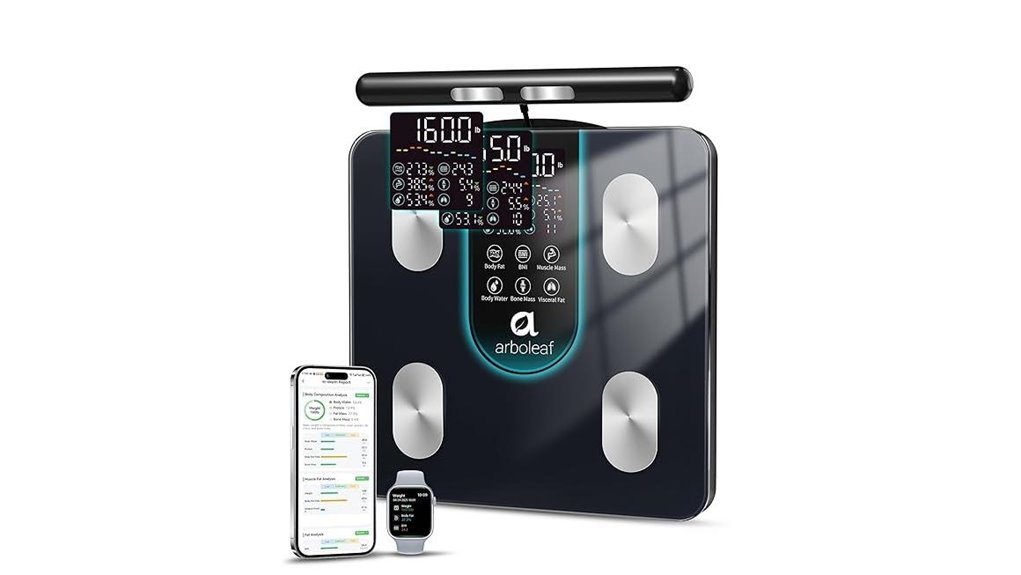
If you want deep, app-backed body composition insights, the Arboleaf 8-Electrode Scale stands out with its 8-electrode dual-frequency BIA technology and 7-in-1 on-scale display that serves quick daily checks while offering 50+ metrics in the companion app. You get instant readings—weight, BMI, body fat, muscle mass, body water, bone mass, visceral fat—with straightforward, on-scale results. In the app, track segmental muscle and fat, fat-free mass, BMR, and body type, plus weekly to yearly trends. It supports multiple users, auto-recognizes profiles, and syncs to major health ecosystems, including Apple Health, Samsung Health, Health Connect, and Fitbit.
Best For: Individuals or households seeking a comprehensive, app-backed body composition view with multi-user support and ecosystem syncing.
Pros:
- 8-electrode dual-frequency BIA provides more detailed body composition data than standard scales.
- 50+ metrics in the app with segmental charts and long-term trend tracking.
- Multi-user recognition (up to 8 profiles) and syncing with Apple Health, Samsung Health, Health Connect, and Fitbit.
Cons:
- Requires app setup and pairing; on-scale display is basic compared to the app’s depth.
- Safety note excludes use with pacemakers or during pregnancy.
- Higher complexity and price point may be overkill for users seeking only basic weight tracking.
RunStar Smart Scale with Body Fat Percentage Monitor

With an all-in-one display that shows weight, body fat rate, BMI, heart rate, and body type in 15 seconds, the RunStar Smart Scale with Body Fat Percentage Monitor is a standout choice for anyone who wants quick, all-encompassing metrics without pulling out a phone. It delivers precision to 0.1 lb / 0.05 kg and handles up to 400 lb / 180 kg. Four high-sensitivity electrodes and four G-shaped sensors pass over 100,000 performance tests. Twenty-two metrics reveal detailed insights, while Starfit app syncing (Apple Health, Health Connect, Fitbit) enables long-term tracking and offline measurement after initial setup. Up to 24 profiles support families.
Best For: Fitness enthusiasts and households seeking quick, comprehensive body composition insights without always using a phone.
Pros:
- All-in-one large display shows 5 key metrics within 15 seconds, even offline.
- High precision measurement up to 0.1 lb / 0.05 kg and support for up to 400 lb / 180 kg.
- Supports up to 24 user profiles with automatic identification for family use and Baby Mode for tracking babies or pets.
Cons:
- Requires initial app connection to enable live scale-to-app syncing.
- 22 metrics may be more data than casual users need, potentially overwhelming.
- Dependence on Starfit app ecosystem for full functionality and long-term tracking.
Arboleaf Smart Body Weight Scale with BMI Metrics
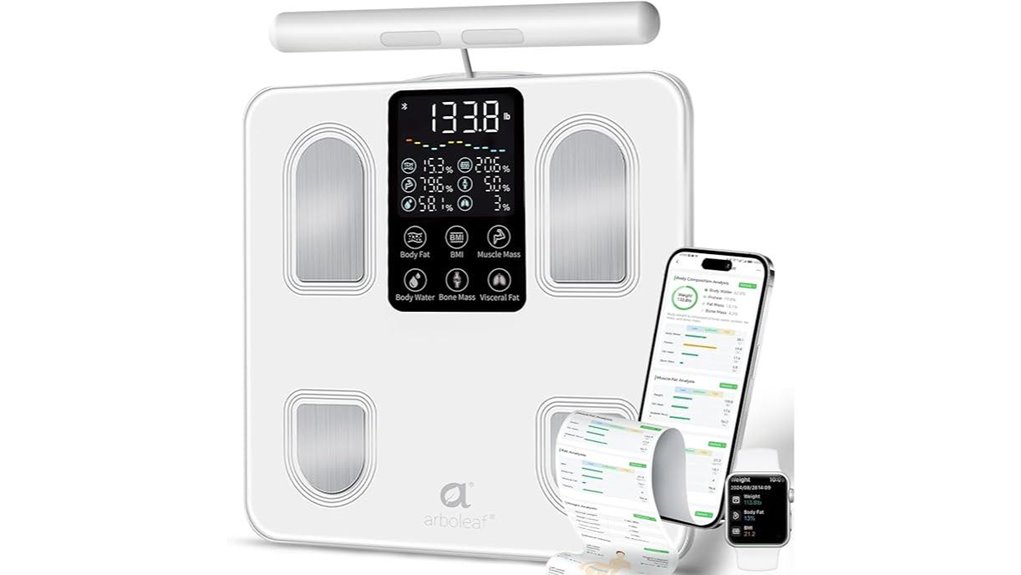
Arboleaf’s Smart Body Weight Scale with BMI Metrics stands out for households wanting deep, multi-sensor insight without constant app use. You get 50+ metrics from 8-electrode tech, including weight, BMI, body fat %, visceral fat, muscle, bone, water, BMR, and more, with full-body analysis across arms, legs, and torso. The extra-large, tip-resistant 12.2-inch platform and bright LED display show 7 metrics in rotation, no app needed for basic read. It syncs via Bluetooth to the Arboleaf app, auto-generating weekly, monthly, and yearly charts, and works with Apple Health, Google Fit, and Fitbit. Auto-recognition supports multiple users plus guest mode. Safety notes apply.
Best For: households seeking deep, multi-sensor body composition data with optional app usage, multi-user recognition, and a large display for quick measurements.
Pros:
- 50+ metrics from 8-electrode tech (weight, BMI, body fat %, visceral fat, muscle, bone, water, BMR, etc.)
- Full-body analysis (arms, legs, torso) with auto-recognition for multiple users and guest mode
- Large, tip-resistant 12.2-inch platform with an LED display; no app needed for basic read
Cons:
- May require app for full charting and long-term tracking (weekly/monthly/yearly) and integration with Apple Health/Google Fit/Fitbit
- Precautions for pacemakers or pregnancy; not suitable for all users
- Setup involves pairing with an app and entering height/age; some users prefer entirely app-free experiences
Lepulse Smart Body Weight Scale with BMI Metrics
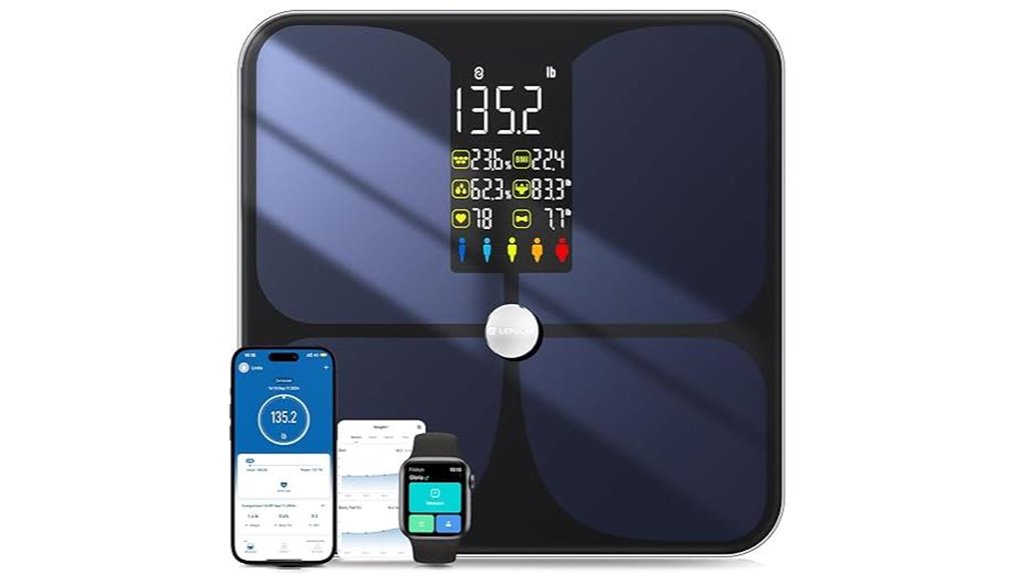
Looking for a scale that tracks a thorough set of body metrics without complicating setup? Lepulse delivers with 20 metrics via Bio-electrical Impedance Analysis, including weight, body fat, BMI, muscle mass, heart rate, water weight, bone mass, BMR, and 12 others. Readings are precise to 0.1 lb / 0.05 kg, with a 400 lb max. The 4.68-inch LCD shows 8 key metrics at a glance, and you can store 24 data sets for clear progress. It syncs over Bluetooth 4.0 to Fitdays, works with Fitbit, Google Fit, Apple Health, Samsung Health, and supports offline measurements. Unlimited users and automatic recognition complete the package.
Best For: Those who want a comprehensive body composition readout with broad app integration and multi-user support, while keeping setup quick and simple.
Pros:
- Wide metric range (20 metrics) with precise readings (0.1 lb / 0.05 kg) and a 400 lb capacity
- Easy Bluetooth setup, automatic user recognition, and unlimited user profiles in Fitdays
- Good display and data visualization with 24 stored data sets and compatibility with major health ecosystems (Fitbit, Google Fit, Apple Health, Samsung Health)
Cons:
- Bluetooth-only setup may require app usage for full features and trends
- Some users may rely on the separate Fitdays app for full 20 metrics and long-term trends
- Offline measurement is available after initial connection, which may limit fully offline usage for new users
GE Body Weight & Body Composition Scale with Bluetooth 400 lb
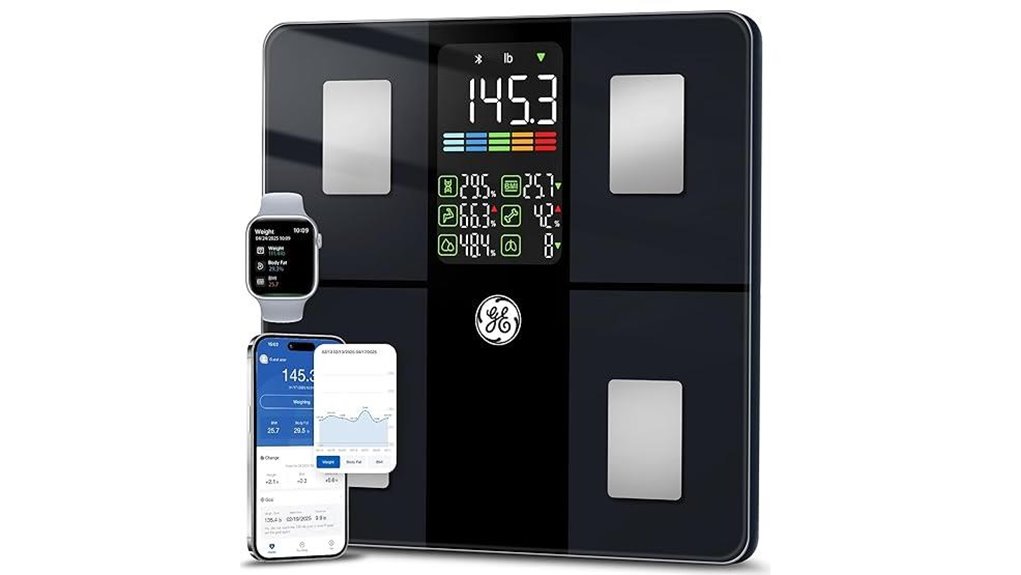
If you want a reliable, budget-friendly option for tracking a broad set of metrics at home, the GE Body Weight & Body Composition Scale with Bluetooth 400 lb stands out for its 14-body composition metrics and strong app integration. You get weight, BMI, body fat, muscle mass, water, visceral fat, bone mass, and body type at a glance, plus 6 additional metrics for deeper insight. The 5.3″ color display, 11×11 platform, and anti-slip surface keep readings clear. With Bluetooth, Fit Profile, and multi-user support, data syncs to Apple Health, Samsung Health, Health Connect, and Fitbit. Simple setup, durable tempered glass.
Best For: Budget-conscious individuals who want a broad set of body composition metrics tracked at home with solid app integration.
Pros:
- 14 body composition metrics including weight, BMI, body fat, muscle mass, water, and more for comprehensive tracking
- Bluetooth connectivity with multi-user support and strong app ecosystem (Fit Profile, Apple Health, Samsung Health, Health Connect, Fitbit)
- Clear 5.3″ color display, durable tempered glass platform, and simple setup
Cons:
- 400 lb weight capacity may be limiting for some users over time
- Some advanced metrics may require regular syncing and interpretation within the app
- May lack advanced on-device analytics and require smartphone pairing for full insights
Etekcity Smart Scale: BMI, Body Fat, Bluetooth Sync
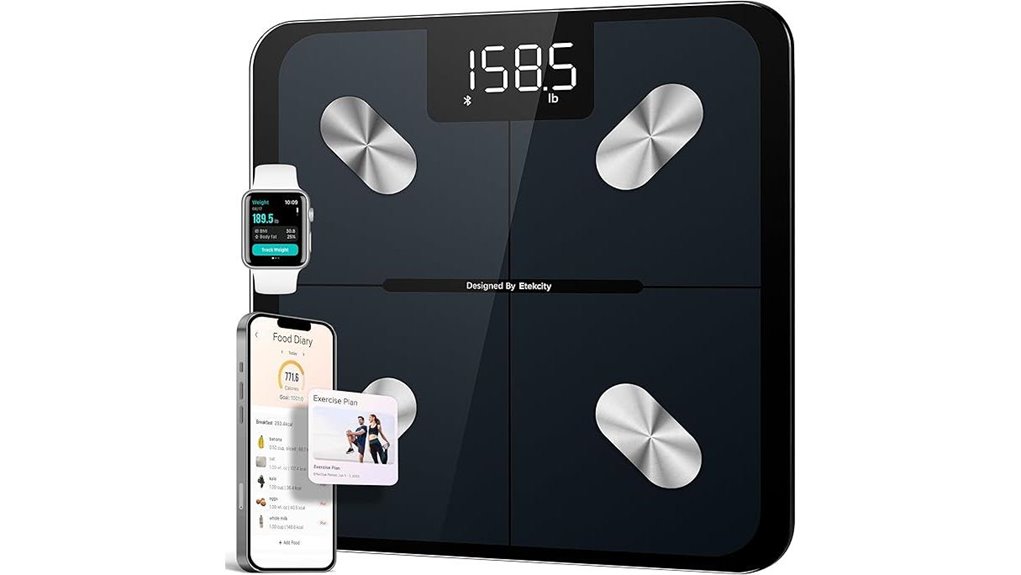
The Etekcity Smart Scale stands out for users who want a thorough BMI and body composition readout plus seamless Bluetooth syncing. You get BMI, body fat, muscle mass, and 13 biometrics with high-precision sensors that register increments as small as 0.05 lb. Features like Zero-Current, Baby, and Light Item Modes add versatility for light items and precise measurements. The free VeSync app delivers personalized diet and exercise plans and syncs with Apple Health, Samsung Health, Google Fit, FitGap, and MyFitnessPal, while supporting unlimited users. It’s compatible with Apple Watch and supports Alexa for hands-free control, promising reliable, privacy-forward home health tracking.
Best For: Users who want a comprehensive body composition readout with reliable Bluetooth syncing and broad app integrations for tracking and privacy-focused home health monitoring.
Pros:
- Measures BMI, body fat, muscle mass, and 13 biometrics with high-precision sensors (increments as small as 0.05 lb)
- Free VeSync app offers personalized plans and seamless syncing with major health platforms (Apple Health, Samsung Health, Google Fit, FitBit, MyFitnessPal)
- Supports unlimited users, Alexa hands-free control, and is compatible with Apple Watch
Cons:
- Some integrations listed (e.g., FitGap) may be a typo; users should verify supported apps before relying on specific connections
- Feature set relies on VeSync app ecosystem, which may require consistent app updates and account management
- Advanced metrics and Baby/Light Item modes may be more than casual users need, potentially adding setup complexity for newcomers
Factors to Consider When Choosing Smart Scale Body Metrics
When you pick a smart scale, start with key metrics depth to guarantee it covers what you actually track, from body fat to muscle mass. Consider the app ecosystem access so your data syncs smoothly and you can export insights. Also check user profiles capacity, display readability, and measurement accuracy to avoid surprises down the line.
Key Metrics Depth
Choosing smart scales with the right body metrics comes down to balancing what you want to track with how you’ll use the data. Most scales measure a core set—weight, body fat percentage, BMI, muscle mass, and body water—often expanding to 8–22 metrics with segmental analysis. BIA powers these insights, using multiple electrodes to estimate fat, muscle, bone, and water distribution. Some models display 5–8 key metrics directly on the device, with deeper details available in the app. You’ll likely get long-term tracking via daily, weekly, and monthly trend charts, plus integration with Apple Health, Google Fit, and Fitbit. Automatic multi-user recognition and profiles ensure data stays with the right person, enabling personalized metric interpretation across households.
App Ecosystem Access
As you compare metrics, consider how the app ecosystem houses and presents your data. Most scales sync to Apple Health, Google Fit, and/or Fitbit, enabling cross-device health tracking. Some models offer automatic recognition and multi-user support within the companion app, simplifying long-term trend analysis for families. Apps typically store historical measurements and visualize trends through charts, improving adherence to fitness goals. A few scales support offline data storage or limited on-device displays, with full analytics available only after app pairing. Integration quality and initial setup vary: some require a one-time app pairing to enable all metrics, while others display core metrics directly on the scale with optional app sync. Choose ecosystems that align with your preferred services and data-view needs.
User Profiles Capacity
User profiles matter, especially if multiple people share a scale. Most scales support multiple user profiles, with limits from unlimited (or up to 24) automatic recognitions per scale. Automatic user recognition enables instant results for the correct user when you step on, often without manual switching. Some scales offer guest modes in addition to main profiles to track measurements without saving to a specific user. Family-friendly models commonly provide 8 to 24 distinct profiles to accommodate several members or households. For accuracy, ensure the scale’s auto-recognition threshold aligns with your typical weight changes and that weight-based switching won’t confuse profiles during shared use. Consider how easy it is to add or remove profiles as your household changes.
Display And Readout
When you pick a smart scale, prioritize the display and readout options that make quick sense at a glance. Look for an extra-large or high-contrast display (LED or VA) to read weight, BMI, and key metrics instantly. Check how many metrics appear on the screen during measurement—7, 8, or more—and whether additional data show up only in the app. Note whether the display rotates a set of 5–8 core metrics or shows all values simultaneously, which affects quick daily checks. Verify on-device readouts for rapid viewing without pairing, and if on-screen trend indicators exist. Consider a clear, color-coded layout or icons to distinguish weight, body fat, muscle mass, and other metrics at a glance.
Measurement Accuracy
Measurement accuracy hinges on how granular the scale can read and how stable readings stay across sessions. You’ll want precision around 0.1 lb (0.05–0.1 kg) or finer, with some models offering 0.05 kg (0.1 lb) steps for tighter tracking. The choice between 4-electrode and 8-electrode BIA matters: 8-electrode systems usually give deeper, segmental data and better accuracy. Dual‑frequency BIA and high‑sensitivity electrodes aim to stabilize readings and reduce day‑to‑day variability. Look for automatic user recognition and auto‑calibration, which help keep results consistent, but note you may need to input height or age for precise body metrics. On‑scale readouts cover core metrics, while app dashboards track 20+ metrics over time to verify accuracy and trends.
Safety And Limits
Safety and limits matter just as accuracy does, because even the best scales can give misleading results if you ignore how they’re meant to be used. If you have a pacemaker or implanted device, don’t use a scale without clinician approval, since several models flag this risk. The measurements aren’t universally safe for pregnancy, osteoporosis, or during gestation, due to safety and accuracy limits. Some scales advise weight with shoes on or avoid certain readings if implants contraindicate it. Baby, pet, or child modes exist, but rely on adult supervision and proper use on a hard, flat surface. Always complete one‑time setup steps—app pairing, height, and age input—and heed disclaimers about accuracy on uneven surfaces or with medical implants.
Setup And Pairing
Most smart scales require a one-time setup to pair with your phone’s health app, so data can sync automatically after you weigh in. First, expect to enter basic profile details like height, and sometimes age, so metrics stay accurate across sessions. Automatic user recognition helps you avoid manual switching, assigning measurements to the right profile when you step on or begin a session. You’ll typically connect to Apple Health, Google Fit, Fitbit, Samsung Health, or the scale’s native app for seamless syncing. Some models also support offline operation, storing data locally until you can sync again, which is handy when your phone isn’t nearby. Plan for a quick initial setup, then enjoy continuous, automatic tracking.
Common Questions
How Accurate Are Smart Scales for Bone Density Measurements?
Body density estimates from smart scales aren’t accurate for bone density. They mainly rely on bioelectrical impedance and don’t directly measure bone mineral content. So you’ll see helpful trends for body fat or lean mass, but not reliable bone density results. If you need bone health data, use a DEXA scan or certified clinical test. Smart scales can prompt conversations with your clinician, but don’t replace medical evaluations for osteoporosis risk.
Do Scales Require Wi-Fi or Just Bluetooth to Sync Data?
They don’t always require Wi‑Fi; many scales sync via Bluetooth to your phone first, then upload online when you have a connection. If you want cloud access or multi‑device syncing, you’ll benefit from a Wi‑Fi option. Check your model’s app—some use Bluetooth only, others add Wi‑Fi for faster, hands‑off syncing. In short: Bluetooth is common for local syncing, Wi‑Fi adds seamless automatic backup.
Can Multiple Users Track Individual Progress Accurately?
Yes, multiple users can track their progress accurately. Look for scales that support multi-user profiles with auto-recognition or manual switching. Each person should have their own profile, with distinct goals and units. Ensure the device saves data locally or syncs to an app tied to your account, so measurements remain separate. Regularly calibrate the scale and weigh at similar times. Use bioimpedance settings consistently if you rely on body metrics beyond weight.
Do Scales Measure Water Weight or Hydration Status?
Water weight can wobble your reading, but most scales don’t measure hydration status directly. They estimate body composition using bioimpedance, which can reflect recent fluid shifts, not precise hydration. So you’ll see changes from meals, sweat, or caffeine, not a true hydration metric. As the old saying goes: “you can’t judge a book by its cover.” You’ll want clinical tests or advanced devices for true hydration status, rather than a standard home scale.
Are There Privacy Concerns With App Data Sharing?
Yes, there can be privacy concerns with app data sharing. When you sync a scale’s app to the cloud, your measurements, trends, and account details may be accessible by the vendor and, in some cases, third parties. Check privacy policies, opt out of data sharing, enable two-factor authentication, and review permissions. Use local-only modes if available. Regularly audit connected apps, revoke unused access, and keep your software updated to minimize risk.
All Together
Choosing the right smart scale makes tracking easy and motivating. These models offer 8–14 metrics, auto‑recognition, and syncing with Apple Health, Google Fit, and more, so you stay on top of trends without manual logs. For example, a busy mom used a scale with body fat and skeletal muscle readouts to tailor workouts and saw a 6% muscle gain in 8 weeks. Pick one that fits your metrics, ecosystem, and daily routine.